
Philosophy with Integrity
Layered Gas Detection System 본문
Layerd gas detection system: A layered gas detection system uses multiple types of sensors and technologies to detect gas leaks, offering redundancy and improved overall safety. This approach allows for early detection of leaks, enabling faster intervention and preventing hazardous situations. By combining different detection methods, a layered system can minimize blind spots and improve the likelihood of detecting gas hazards.
- redundancy
- Early warning
- Comprehensive coverage
- Diverse technologies
- Flame detection
- Fixed and portable detection
- Integration
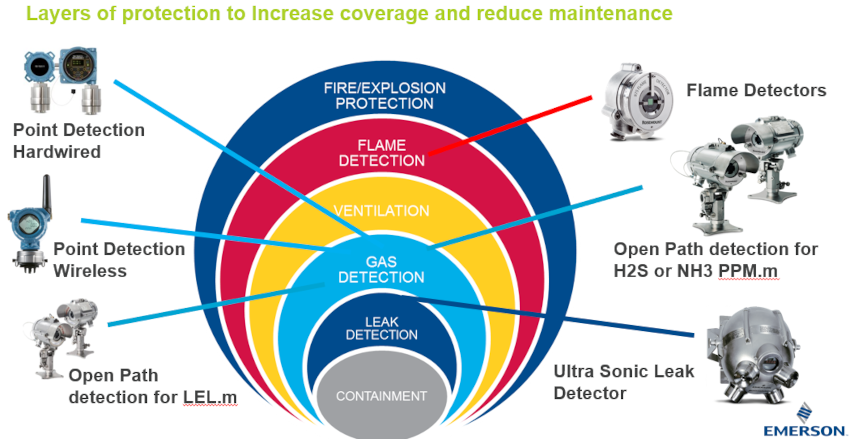
Often, detection systems are comprised of a combination of point detector technology, open-path technology, ultrasonic or acoustic gas detectors and flame detection.
- Layer 1a: Point Infrared Gas Detection. near potential leak sources such as valves, flanges and pumps, offering a foundational layer of protection. By installing multiple devices, you can gain a more accurate map of gas release events. These gas detectors provide continuous monitoring to detect gas clouds that could cause structural damage in case of an explosion. However, the gas must reach the detection point, which does not happen if the wind moves the gas cloud away from the detector or is dissipated before reaching the detector.
- Layer 1b: Open Path Infrared Gas Detection. less sensitive to wind speed and direction than point detection. for long range perimeter or fence line monitoring from 60 to 330 meters (196 to 1083 feet), so that worksite employees can both monitor whether they are emitting harmful gases into neighboring areas or if neighboring plants have leaks of their own that need to be addressed. It also provides critical data on threat levels based on gas concentration and size, enabling plant operators to make informed decisions.
- Layer 1c: Ultrasonic Gas Leak Technology. The technology can ‘hear’ the ultrasounds emitted by escaping gas at the speed of sound, buying plant personnel critical time to respond. Even small and low-pressure leaks can be identified, eliminating challenges other gas detection systems face like changing wind directions or gas dilution in the open air. will not provide any indication of the gas type or concentration.
- Layer 2: Flame Detection
The layers of gas detection can be categorized based on their location, sensitivity, and technology:
- Perimeter/Area Monitoring: This outermost layer involves deploying fixed gas detectors strategically around the perimeter of a hydrogen handling facility or within specific process areas. These detectors provide continuous monitoring for general leaks and are designed to trigger alarms at relatively low concentrations (e.g., 10-20% of the Lower Explosive Limit - LEL). Examples include catalytic bead sensors, electrochemical sensors, and semiconductor sensors.
- Local/Point Monitoring: Located closer to potential leak sources, such as pipelines, valves, and equipment connections, these detectors offer a more localized and often faster response to developing leaks. They are typically set to alarm at slightly higher concentrations than perimeter monitors (e.g., 20-40% LEL).
- Near-Source/Equipment Monitoring: This innermost layer involves integrating gas sensors directly into or very near critical equipment where leaks are most likely to occur. These detectors are designed for rapid detection of even small leaks and can trigger immediate local alarms or automated safety shutdowns. Advanced sensor technologies like microelectromechanical systems (MEMS) based sensors or tunable diode laser absorption spectroscopy (TDLAS) can be employed for their sensitivity and fast response times.
- Personal Gas Monitors: Equipped by personnel working in areas where hydrogen may be present, these portable devices provide an additional layer of safety by alerting individuals to localized leaks or elevated concentrations in their immediate vicinity. These monitors typically incorporate multiple sensor technologies to detect various hazards, including hydrogen.
실제로 누출을 감지하기 위한 gas detector
정확한 농도를 알기위한 gas detector
그렇다면 alarm 1 & 2 의 의미는? process alarm과 개념이 다름.
누액감지기 황산
'내일 공부' 카테고리의 다른 글
| 공부법 그리고 엔지니어의 역량 (1) | 2025.05.28 |
|---|---|
| HAC- ignition probability (0) | 2025.05.28 |
| Building의 ventilation type과 그 정도를 결정하는 절차 및 기준 (0) | 2025.05.25 |
| Compressor shelter내의 HC 누출로 인한 화재/폭발 예방 방안 (2): Ventilation (0) | 2025.05.24 |
| Column skirt에 내부에도 내화 (fireproofing)를 적용하는 것이 적절한가? (0) | 2025.05.23 |

