
Philosophy with Integrity
Fire Scenario 본문
Pool fires
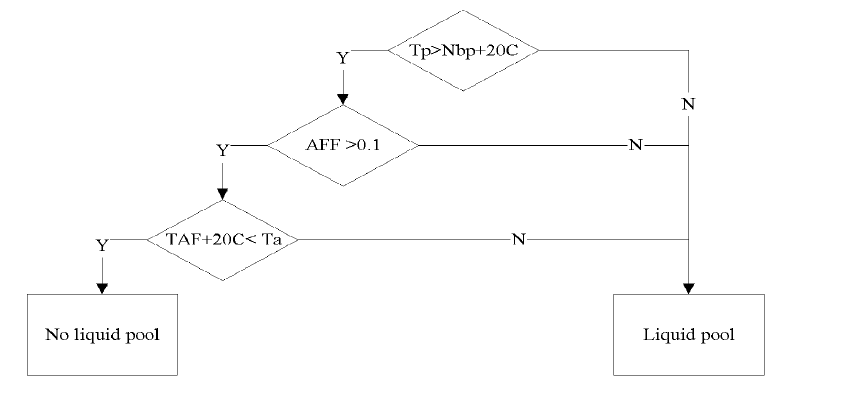
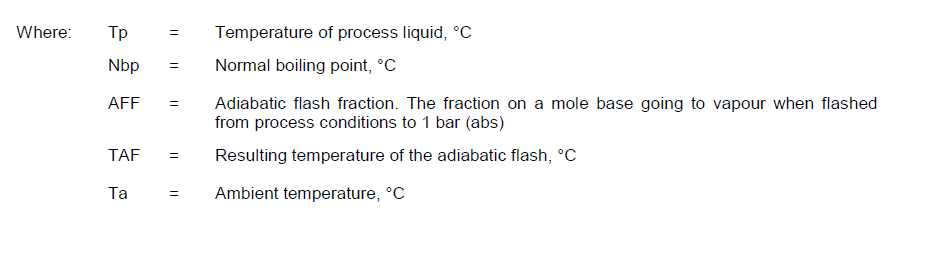
Liquid pools can be formed by all hydrocarbon products containing pentane and heavier components but also by butanes/butenes at ambient temperatures below 0 °C. Additionally, propane and lighter refrigerated/cryogenic liquefied gases (e.g. LNG) may also form liquid pools in the event of accidental leakage while they are handled at temperatures at or near their atmospheric boiling points. In particular, this may be the case during a prolonged leakage if the rate of leakage exceeds the rate of vaporisation. For the above categories the possibility of pool fires has therefore to be taken into account. The formation of a pool is determined by the effects of mechanical break-up of the jet caused by the high velocity and thermal break-up due to flashing of the liquid. The result is an aerosol jet, which might rain out and form a pool. With the aid of the following decision tree it can be decided whether rainout occurs. [1]
Pool fire arise where pool formation of flammable/combustible liquids burns. Based on the composition, pool fire can generate large quantities of smoke. Liquid pools can be formed by all hydrocarbon products containing pentane and heavier components. Additionally, propane and lighter refrigerated/cryogenic liquefied gases may also form liquid pools in the event of accidental leakage while they are handled at temperatures at or near their atmospheric boiling points. Size of the pool and smoke generation plays an important role in determining the radiated heat and therefore needs to be taken into account while determining the Surface Emissive Power (SEP) of pool fires. [2]
A turbulent diffusion flame burning above a horizontal pool of vaporizing fuel under conditions where the fuel vapor or
gas has zero or very little initial momentum.[4]
The nature of pool fires is reasonably predictable: they form on horizontal surfaces (typically the ground) and radiate
heat both up and out. They are single phase, not pressurized, and the affected “envelope” boundaries can be
reasonably defined or calculated [3, 4, 5]. With knowledge of characteristics and inventories of potential fuel a general
pool fire scenario can be developed for a facility.[4]]
Jet fires
A flash fire can occur when the combustion of a flammable liquid and vapour results in a flame passing through the mixture at less than sonic velocity. Damaging overpressures are usually negligible, but severe injuries can result to personnel if caught up in the flame. Also, a flash fire may travel back to the source of any release and cause a jet fire if the release is pressurised [1]
Jet fire arises from ignition of a high velocity gas, aerosol, 2 phase or liquid release, usually from a pressurized source. Pressurized liquefied gases which will not form liquid pools upon release will disperse as a vaporizing liquid aerosol jet. Ignition of liquid or a vapour jet results in a jet fire which may cause impinging flames with high radiation intensities. The length and width of unobstructed jet flames vary as a function of the pressure upstream of the leak, the size and geometry of the hole and the wind speed. The composition of the fluid including water cut plays an important role in determining the jet fire intensity.[2]
Jet fire characteristics include unpredictability of the source (leak) and flame impingement locations, unpredictability
of the jet flame length, and significantly increased heat loading to the vessel’s wetted and unwetted surfaces relative
to a pool fire (see Annex A). In addition, potential mitigation measures (e.g. water spray) can be adversely impacted
by the effect of the jet fire velocity. [3]
A turbulent diffusion flame resulting from the combustion of a pressurized fuel continuously released with some
significant momentum in a particular direction or directions. Jet fires (sometimes called torch fires) can arise from
pressurized releases of gaseous, flashing liquid (two phase) and pure liquid inventories.[4]
The nature and circumstances associated with jet fires makes a scenario-development process comparable to pool
fires very difficult. Significant differences are: jet fires are pressure fed, are typically elevated above ground level, are
randomly directional, can create immediate localized heat flux, and vary in length and duration. They are highly
dependent on many factors, including release source (hole size and configuration), fuel inventory, pressure,
temperature, wind, obstacles in the jet plume path, and phase of the fuel as it is released. Jet fires transfer heat by
radiation, convection, and conduction. By their nature jet fires can be erosive to the materials they impinge. [4]
Analysis of historical incidents may help facilities identify
and address areas of potential vulnerability such as: deadlegs; freeze vulnerability, vibration susceptible, or trafficexposed
process piping; or corrosion under insulation. Effective prevention includes integrating knowledge of past
events into surveillance, recognition and correction of identified concerns (e.g. PRV vent piping directed toward a
vessel or other structure). [4]
Flash fires
A flash fire can occur when the combustion of a flammable liquid and vapour results in a flame passing through the mixture at less than sonic velocity. Damaging overpressures are usually negligible, but severe injuries can result to personnel if caught up in the flame. Also, a flash fire may travel back to the source of any release and cause a jet fire if the release is pressurised [1]
The duration of flash fires and fireballs will be very short (<1-2 sec, and < a minute, respectively), meaning that the thermal radiation will not last long enough to cause significant heating of any HSECES to weaken it, PFP is therefore not relevant. [5]
VCE
A flash fire can occur when the combustion of a flammable liquid and vapour results in a flame passing through the mixture at less than sonic velocity. Damaging overpressures are usually negligible, but severe injuries can result to personnel if caught up in the flame. Also, a flash fire may travel back to the source of any release and cause a jet fire if the release is pressurised [1]
Explosions are due to the sudden release of energy over a very short period of time and may or may not involve combustion or other chemical reactions. It is possible for a fire to lead to an explosion and an explosion might lead to a fire and secondary explosions if combustible gases or liquids are involved. An explosion is defined as a rapid expansion of gases resulting in a rapidly moving pressure or shock wave of sufficient magnitude to cause potential damage or injury.
A vapour cloud explosion is results of release of flammable material in the atmosphere, a subsequent release phase, and after some delay, an ignition of the vapour cloud. Vapour cloud explosions generated from a release of flammable vapour can explode with widespread damage to plant and property and injury and or fatalities to people. A flame must propagate at a considerable speed or cloud has to be ignited very strongly to cause vapour cloud to explode.[2]
Flame acceleration is only possible if following conditions are met and therefore deciding the propensity and intensity of the vapour cloud explosion. These factors are checked while determining the potential explosion sites.
In the presence of outdoor obstacles, for example, congestion due to pipe racks, weather canopies, tanks, process columns, multilevel process structures, etc.;
In a high momentum release causing turbulence, for example, an explosively dispersed cloud or jet release; and
In combination of high momentum releases and congestion [2]
BLEVE
A flash fire can occur when the combustion of a flammable liquid and vapour results in a flame passing through the mixture at less than sonic velocity. Damaging overpressures are usually negligible, but severe injuries can result to personnel if caught up in the flame. Also, a flash fire may travel back to the source of any release and cause a jet fire if the release is pressurised. [1]
Once a fire or explosion/fire sequence of hazardous events has started, escalation may occur due to vessel rapture scenarios due to high pressure arising from over-pressurization and/or reduction in vessel strength due to overheating from external fires. A vessel rupture produces three primary effects:
Release of vessel content;
Fragmentation of the vessel coupled with missile effects; and
Blast due to the expansion of the pressurized contents.
The release of secondary content can cause secondary effects, such as buoyant fireball with heat radiation (if escalation is due to fire), a vapor cloud explosion, a flash fire or dispersion of a toxic material.
A BLEVE Is explosion resulting from the failure of a vessel containing a liquid at a temperature significantly above its boiling point at normal atmospheric pressure, e.g. liquefied petroleum gases. The fluid in the vessel is usually combination of liquid and vapor. If the vessel ruptures, vapor is vented and the pressure in the liquid drops significantly. This leads to instantaneous boiling throughout the liquid, through this process, a large fraction of the liquid can be vaporized in a very short time. The liberated energy in such case is very high causing high blast pressure and fireball due to ignition from external fire. [2]
Boilover
The boilover phenomenon is defined as a violent ejection of fuel due to the vaporization of a water sub-layer, resulting in an enormous fire enlargement and formation of boilover heat radiation and ground fire.
A boilover appears with the burning of oil or flammable fluid, viscous enough to enable formation of froth, the presence of a water sub-layer, and the apparition of a zone of nearly constant temperature inside the fuel. This hot-zone (wave of heat) has an expansion rate higher than the burning rate of the hydrocarbon free surface and therefore enhances the heat propagation downwards the water layer, decreases the time of boilover apparition, and increases the intensity of consequences which mainly consist in flame enlargement and radiation increase.
Radiation from boilover are very intense and expands to a much larger area and can be a serious threat to adjacent facilities and firefighters. [2]
ATM tank fires [1]
a) Vent Fire
A vent fire is a fire in which one or more of the vents in a fixed roof tank or internal floating roof tank has ignited.
b) Fixed Roof Tank Full Surface Fire
A full surface fire in a fixed roof tank can be caused by static discharge, lightning strike or vapour space explosion. A vapour space explosion can occur if the vapour space is within a flammable range and this is ignited either by hot tank surfaces (fire heated surfaces greater than the auto-ignition temperature) or by a flash back (through tank
openings, defective flame arrestor, etc.) If the tank is constructed to have a frangible roof (see API 650 for an example of design requirements) then the roof should separate from the tank shell along a weak seam. Depending on the force of the vapour space explosion, the roof may either be partially removed (creating a fish mouth opening) or
fully removed.
c) Floating Roof Tank Rim Seal Fire
A rim seal fire is one where the seal between the tank shell and roof has lost integrity and the vapour in the seal area ignites. The amount of seal involved in the fire can vary from a small-localised area up to the full circumference of the tank. The flammable vapour can occur in various parts of the seal depending on the seal design.
d) Floating Roof Tank Full Surface Fire
A full surface fire is one where the tank roof has lost its buoyancy and some or the entire surface of liquid in the tank is exposed and involved in the fire. If a roof is well maintained and the tank is correctly operated, the risk of a rim seal fire escalating to a full surface fire is normally low.
e) Floating Roof Tank Spill on Roof Fire
A spill-on-roof fire is one where a hydrocarbon spill on the tank roof is ignited but the roof maintains its buoyancy. In addition, flammable vapours escaping through a tank vent or roof fitting may be ignited. It is very difficult to prevent a spill on roof fire from escalating to a full surface fire because most fire fighting systems are designed for fires
in the rim seal area.
f) Bund Fire
A fire in the bund is any type of fire that occurs within the containment area outside the tank shell. These types of fire can range from a small spill incident up to a fire covering the whole bund area. In some cases (such as a fire on a mixer) the resulting fire could incorporate some jet fire characteristics due to the hydrostatic head
Tank Fires:
Storage tank containing flammable and combustible material can undergo various tank fire scenario based on the type of tanks and associated dykes. These are classified as full surface fires, rim seal fires, bund fires, etc. Based on the size and volume the impact and duration of fires may vary from couple of hours to days. If not provided with sufficient protection measures can escalate to scenarios such as boilover. [2]
Reference
- DEP 80.47.10.30, PTS 80.47.10.30
- HSE-RM-ST09 FERA
- API std 521
- API RP 2218
- AGES-PH-03-002 (Part 3) 5.1.1
'내일 공부' 카테고리의 다른 글
| Fire Scenario- Jet fire (0) | 2025.06.25 |
|---|---|
| Chat GPT 활용 시: 주도적인 학습 (1) | 2025.06.24 |
| Escalation for Layout & Spacing: Vessel Rupture (0) | 2025.06.21 |
| Minimum Design Pressure (0) | 2025.06.21 |
| LUP and its criteria (0) | 2025.06.20 |