
Philosophy with Integrity
Fire Protection Strategy: (2) Where EDP can be applied. 본문
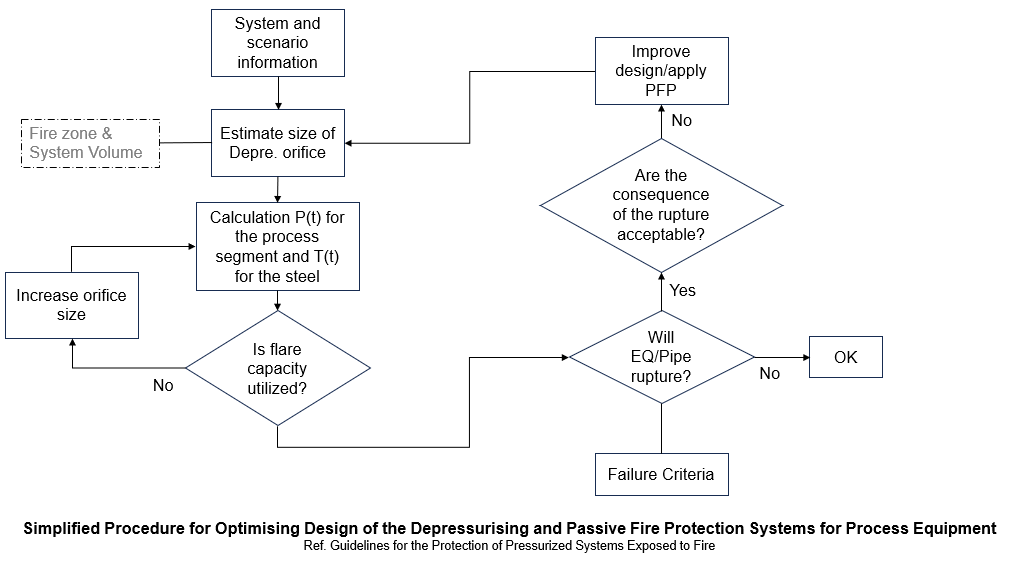
Decision criteria for EDP
Pressurized vessel에 fireproofing을 적용하는 것보다 EDP를 적용하는 것이 risk 측면에서 합리적인 선택이어야 한다. 그런 곳이 어디인지 찾아서 그 기준을 정하는 것이 중요하다.
Pressurized vessel이 external (pool/jet) fires로 부터 heat load에 노출되었을 때 vessel 보호 측면에서 어떤 안전장치들이 있는가? PSV. insulation 등이 있다. Insulation은 외부의 heat을 저감 해주는 역할을 하고 PSV는 external heat으로 인해 내부 압력이 증가하는 것을 PSV를 통해 배출해서 내압을 일정수준이하로 제한한다. 그러나, insulation은 소화과정에서 Fire water의 힘에 의해 손상을 받아 heat 저감효과를 얻을 수 없을 수 있고, PSV는 과압에 대한 대응은 가능하나 그 외의 문제에는 안전장치가 될 수 없다. 문헌[2] 에서 예시로 든 사례는 다음과 같다.
When metal temperature is increased due to fire and exothermic or runaway process reactions, the metal temperature can reach a level at which stress rupture can occur. This can be possible even though the system pressure does not exceed the maximum allowable accumulation. In this case, depressuring reduces the internal stress, thereby extending the life of the vessel at a given temperature.
가해자 입장 (HC leaking)
Leak를 통해 pool fire/jet fire를 유발함.
Fire의 크기를 줄이려면 fuel source supply를 차단하기위해 isolation이 필요함. (Emergency Isolation Valve)
그리고 depressurization 혹은 blowdown하면 좋음. leak rate/ duration 최소화
피해자 입장 (Externally Heat-exposed)
External heat에 따른 Vessel damage/rupture를 예방해야 함
내부 압력을 낮춤. pressure 혹은 thermal stress 줄일 수 있음.
- 이때 내부 물질이 liquid인데 외부 pool fire에 의해 heat 때문에 vaporization/flash/volume이 증가한다면 PSV의 external fire case로 cover가능함. 그리고 holding liquid가 외부 열을 흡수해 metal에 가는 부담이 줄어 vessel rupture 측면에서는 liquid blowdown을 하지 않아도 된다. PSV 외에 별도의 조치는 필요 없음.
- 그러나 jet fire인 경우라면 노출 면적이 좁아서 heat input이 적음. 이런 경우 부분적인 heat exposure에 의한 metal 손상이 압력 accumulation보다 빠를 수 있음. 그래서 vessel damage/rupture로 인해 더 큰 피해가 가능함. 이런 경우는 PSV가 안전장치 역할을 할 수 없음. 별도의 조치가 필요함. fireproofing을 적용할 수 있으나 CUF의 위험이 있고 insulation을 적용할 경우 CUI의 위험이 있어 EDP가 적절함.
- 그러나 내부가 gas이면 extermal fire에 의해 vaporization/flash는 없고 voume expansion은 가능하나 그 차이는 크지 않다. heat exposure에 의한 metal 손상이 압력 accumulation보다 빠를 수 있음. 그래서 vessel damage/rupture로 인해 더 큰 피해가 가능함. 이런 경우는 PSV가 안전장치 역할을 할 수 없음. 별도의 조치가 필요함. fireproofing을 적용할 수 있으나 CUF의 위험이 있고 insulation을 적용할 경우 CUI의 위험이 있어 EDP가 적절함.
EDP를 적용해야하는 system의 기준을 제시한 industrial standard와 corporate standard를 참조하면 다음과 같다.
Industrial Practices, Norsork S-001
All pressure vessels and piping segments, which during shut down contain more than 1,000 kg of
hydrocarbons (liquid and/or gaseous), shall be equipped with a depressurising system. For pressure vessels and piping segments without a depressurising system, containing gas or unstabilised oil with a high gas/oilratio, the maximum containment should be considerably lower than 1,000 kg. Location of segment (enclosed or open area), risk of segment being exposed to a fire, consequence of rupture, etc. should be considered.
API RP 521
A common application is compressor depressurization, in case of a fire, leakage, or seal failure. Another is emergency depressuring for the fire scenario, which is often considered for large process equipment operating at a gauge pressure of 1700 kPa (~250 psi) or higher. This can vary from installation to installation (i.e. it may be different for normally unmanned, remote installation compared to an installation located in populated areas; whether the fluid is LPG, gas, or oil; whether the fluid is toxic or not, etc.). Because the consequences of a vessel rupture (fragmentation and possible BLEVE) normally are larger than for a pipe rupture, pipe rupture can be more acceptable than a vessel rupture. In addition, the user should consider the following when deciding whether these criteria are suitable for their needs:
a) personnel exposure (time to escape, time for rescue actions);
b) potential asset damage;
c) potential for escalation;
d) potential offsite effects;
e) loss of production, reputation;
f) other measures to mitigate overheating due to fire exposure;
g) frequency of the fire scenario (i.e. risk analysis).
Company T
| BDV required | ||
| Piping or Vessel |
That cannot be isolated | No |
| That can be isolation, but cannot be exposed fire (Note 1) |
No (Note 2) | |
| That can be isolated, and can be exposed to be fire (Note 1,3) |
||
| Flammable gas | P> 7barg and PVgas >100bar*m3 (Note 5) | |
| Two-phase | ||
| Liquefied HC (Note 4) | Mgas or Mliq > 2 tonnes of C4 or more volatile | |
| Liquid HC | No (Note 6) | |
| Toxic gas | As required for the protection of personnel | |
| P: Max operating pressure (PSHH, initial operating pressure) | ||
| Vgas: Max gas volume inside vessel or piping or both (LSLL) | ||
| Mgas: Max mass of HC gaseous phase inside vessel and/or piping | ||
| Mliq: Max mass liquefied HC phase inside vessel and/or piping |
| Notes |
| 1. Isolation performed manually and/or automatically |
| 2. Except piping interconnecting equipment or vessels between other vessels already subject to EDP within the same process unit, regardless of pressure and volume. |
| 3. Piping for vessels shall be considered as being possibly exposed to fire if part or the whole of it is inside the 3D Fire Scenario Envelope (FSE) defined as a cylinder with a default radius 12m and height 7.5 m or a jet fire lasting more than 3 minutes. Default values may be adapted to specific hydrocarbons risks. |
| 4. Either refrigerated or under pressure |
| 5. The presence of pressurized fluid "trapped" in the network after EDP shall be avoided (the position of control valves failing to close and/or check valves shall be carefully contemplated) |
| 6. PSV or TSV fire case shall be considered as sufficient protection |
Gas service인 경우 system pressure가 7 barg 이상이면서 일정 이상의 용량을 가진 pressurized system은 EDP가 필요하고, liquid service의 경우 EDP는 필요하지 않다는 것이 Company T의 practice이다. 이는 위에서 언급한 case 별로 적절한 안전장치를 도출한 내용과 일치한다고 생각한다. 다만, 그 용량의 기준이 어떤 기준으로 도출되었는지는 자체적인 확인이 필요해 보인다. 그리고 화재를 대비하여 pump out을 위한 설비들을 고려하는 경우가 있는데 이는 어떤 service를 위한 것인지 고민해 볼 필요가 있다.
다음은, EDP를 적용해야 하는 시스템의 depressurizing rate는 어떻게 구할 수 있는지 검토할 예정이다.
References
- Guidelines for the Protection of Pressurized Systems Exposed to Fire, Scandpower
- API RP 521
- Norsok S-001
- CCPS, Guidelines for Engineering Design for Process Safety 7.4
'내일 공부' 카테고리의 다른 글
| Fire Zone (0) | 2025.06.14 |
|---|---|
| Fire Heat Intensities (0) | 2025.06.14 |
| Fire Protection Strategy: (1) Establishment (0) | 2025.06.14 |
| Explosion 예방대책 (0) | 2025.06.14 |
| Target of design for Fire Protection (2) | 2025.06.09 |
