
Philosophy with Integrity
[Complete Reading] FGS and Fire Protection System Philosophy Part 3- PFP 본문
[Complete Reading] FGS and Fire Protection System Philosophy Part 3- PFP
vegabondsheyla 2025. 7. 4. 14:19Terms & Definitions
Facility > Plant > Process Unit > Process section
Fire Detection Zone (FDZ, F&G zone) -> ER initiated & targeted
Fire Zone: 화재 확산(escalation)을 제한하고 소방 시스템(예: deluge system)의 적용 범위를 정의하는 설계적·방호적 개념으로 구분되는 단위 zone임.
FPrZ Fire protection zone
4. Overall approach to PFP & Document structure
HSECES: "Safety critical" performance
- Functionality
- Availability
- Survivability: PFP
- Dependencies & Interactions
Table 4.1 review
4.1 General
4.2 Key Assumptions
4.3 Pre-requisition
4.4 Overview of Framework
4.5 Application & Compliance with Philosophy
4.6 Document structure
5. Functionality: Principles of PFP application
5.1 HAZID: What are the hazards?
5.1.1 Fire Class
For pool/jet fires. Not for flash fire/fireball because they are not prolonged.
5.1.2 Fire Duration
(1) Likelihood: Leak * ignition => fire
- Leak -small to start with: typical
- Large leaks by external failure: much lower frequency
(2) Size of hazard envelope
- Jet fire: determined by the size of the leak
- Pool fire: determined by the degree of containment (bund, kerbs, drainage, etc to limit the size of a pool fire.)
(3) Duration of hazard envelope
The nature and quantity of fuel
5.2 Identification of HSECES: What are vulnerable HSECES?
- Structure
- Large material inventories (vessels/tanks)
- Process safety systems (ESDV, ROV. BDV, AFP systems (deluge skids, etc.)
- Cabling
- Flare lines, FW lines, etc.
5.3 Principles of Protection: How will it work? 작동원리
MAT (Maximum allowable temperature) of unprotected equipment * a defined time period.
PFP shall prevent the relevant HSECES from reaching its MAT for the duration required to protect it.
5.4 Protection Period: How long to protect?
The time required for the HSECES to survive
- Predicted fire duration, assuming operation of ESD/Isolation/BD, bunding and drainage provisions), but assuming no operation of AFP protection (from FERA)
(1) FERA로 fire duration을 예상할 수 있는가? 입력값이 될 수 있음. jet fire/pool fire
(2) Lower certainty
- Predicted escape, muster and evacuation duration (from EERA)
- Predicted duration for firefighting team to arrive and control of fire (ER philosophy with HSE philosophy)
- Predicted search and rescue durations (from EERA)
Initial estimate: Protection time이 이미 정해진 것들이 있음. 이를 confirm함. 만약 준수하지 못했을 때, FERA의 결과 값과 비교함. 부족하다면 어떤 조치를 해야하는가?
6. Availability: 유지보수
7. Survivability
PFP의 survivability에 영향을 줄 수 있는 요인들
7.1 Process Conditions
일반적으로 hot temperature fluid임. cryogenic temperature에는 취약할 수 있음.
7.2 Pool fires: pool fire test 수행함
7.3 Jet fires: jet fire test 수행함
Jet fire impingement 의 Erosive force, pressure fluctuation, and high heat flux 에 대한 내구성이 있어야 함.
Pool fire and jet fire 둘다 견딜 수 있도록 설계되어야 함. 그리고 test도 함.
7.4 Explosion Resistance
7.5 Environmental Conditions: seawater, sandstorm,etc.
7.6 Cryogenic spills before fires
LNG, Liquid N2, Liquid O2, Liquid Ar, Liquid Ammonia (-33 degC): super-chilled
PTS/PDO fireproofing 자료 확인 필요함. SHELL DEP 개정판
7.7 Interactions with other activities
- Firewater/Foam during firefighting
- Maintenance activities
8. Project Implementation
8.1 ISD perspective
8.2 Project Lifecycle
The main difference for jet fires that the flammable inventory can usually be reduced by isolation and depressurization to control the fire within ina predetermined time frame. This gives an opportunity for the HSECES to survive, meaning that PFP can be avoided along with its downside of extra, cost and maintenance burden.
정보가 부족하므로 prescriptive standard를 적용한다. 그러나 API 2218도 한계는 있다
API RP 2218 의 한계 (inherent assumptions and constraints)
Pool fires affected volume (9*9m)
Coarse fire categorization (low, medium, & high risk)
No consideration of
- HC flash point
- Bund area
- Heat of combustion
- Burning rate
- Flame wild tilt effects
- Flame luminosity
이를 극복하기 위해 FERA와 같은 FHA로 design verification이 필요하다.
"Irrespective" of the optimum PFP requirements based on a specific FERA study.
9. PFP Implementation-Onshore plant
9.1 General
onshore vs offshore
9.2 Flare & Vent lines
Re-routing away from fire sources sufficiently not to be impared or passively fire protected.
9.3 Flare Towers & Ground Flares
Layout/spacing (from KO drum) 으로 affected 가능성을 낮추고 자체 PFP는 하지 않는다.
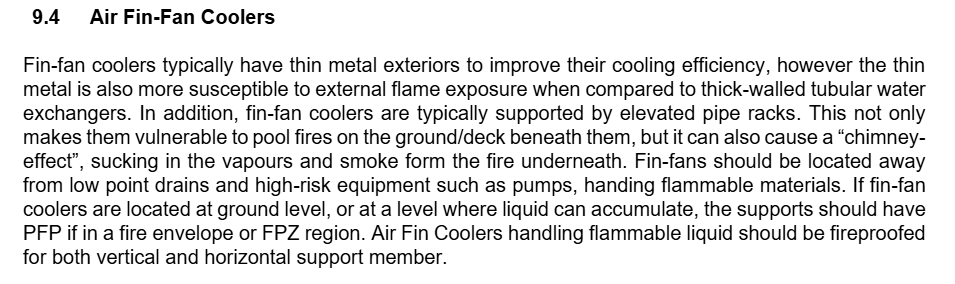
9.4 AFC
finned tube가 상대적으로 fire에 취약함. Thin metal is more susceptible to external flame exposure compared to the thick-walled tubular water exchanger.
AFC are supported by elevated pipe racks. => chimney effect
9.5 Remote & unmanned wellheads
No PFP because no fatalities are expected.
9.6 Utilities
9.6.1 Bottled compressed gases
Layout/spacing. It must be kept away from direct sunlight and located outside of any potential fire envelope.
9.6.2 Firewater ring main
가능 하면 by earth burial
9.6.3 Chemical injection skids and tanks
Layout/spacing. located outside of any potential fire envelope.
만약 external fire에 의해 chemical 누출에 의한 피해가 크다면 FPF해야 한다.
9.7 Stairways, walkways, and access platform -EERA
10. PFP Implementation- onshore building
10.1 Building & Enclosures
10.2 General
10.3 Occupied building at the process plant
10.4 Plant/Process Buildings
10.5 External Boundaries and Walls
10.6 Steel pipe racks, equipment supporting structures
11. PFP Implementation- offshore installations
12. PFP Implementation- other facilities
12.1 Artificial islands
12.2 Refineries
12.3 LPG Process Plants & Storage
12.4 LNG Plants & Storage
12.5 Jetty Terminals
12.6 Helipads and Heliports
13. Earth mounding & Embankment protection
Appendix A 엑셀시트
Appendix B 엑셀시트
Appendix C